
Hi, I’m Jisuk Park (朴智淑).
I have been teaching Japanese for many years and love helping learners discover not only the language itself, but also the joy of learning a new language. I served as Assistant Professor of Japanese Language at the University of Toronto from 2021 to 2025, and previously taught at Columbia University from 2002 to 2019. In addition, I have taught in summer programs such as Princeton University’s Ishikawa Summer Intensive Program and the Hokkaido International Foundation.
My teaching and research interests center on creating meaningful, inclusive, and engaging learning experiences. I focus on language pedagogy, critical pedagogy, project-based learning, curriculum design, and the Social Networking Approach to foreign language education. More recently, I have been working on ways to better support students with learning difficulties. I have served as the editor of Social Networking Approach to Japanese Language Teaching: The Intersection of Language and Culture in the Digital Age (Routledge, 2021), as a co-author of Hiyaku: An Intermediate Japanese Course (Routledge, 2011), and have published extensively on Japanese language education.
Currently, I teach Japanese online, develop online courses, and offer teacher training workshops. I am also involved in educational support and research for migrant children in Japan. In addition, I currently serve as a standing director of the Association for Social Networking Approach and Collaborative Online International Learning (SNA-COIL) and was previously a member of the executive board for the Canadian Association for Japanese Language Education (2020–2024).
Curriculum Vitae (PDF)
Last updated: March 2026
keynote Talk
日本語教育における「中立」の幻想を超えて:学習者の声から考える脱植民地化と再構築
Beyond the Illusion of “Neutrality” in Japanese Language Education: Decolonizing and Reconstructing the Field Through Learners’ Voices May, 23, 2026 JLTANE
In Japanese language education in North America, implicit assumptions such as “learners are white” and “teachers are Japanese speakers of the standard Japanese language” have long been normalized. These assumptions not only marginalize diverse learner populations but also obscure the linguistic, cultural, and historical diversity of Japanese society, including the Ryukyuan and Okinawan communities, the Ainu, Zainichi Koreans, and speakers of regional varieties.
Drawing on my positionality as a Japanese language educator and a third-generation Zainichi Korean, this talk critically examines how “Japan” is represented in Japanese language textbooks and how historical contexts behind these images are selectively framed or erased. For example, while Shinto shrines are commonly portrayed as peaceful and culturally neutral spaces, the historical reality that large numbers of shrines were constructed in colonial territories and that shrine worship was enforced as part of Japan’s imperial assimilation policies (Nakajima 2010) is frequently absent from instructional materials.
The talk also addresses contemporary debates surrounding assessment practices grounded in notions of “correct” or “standard” pronunciation. Situating these practices within the historical context of the 1923 Great Kantō Earthquake—when “tameshi kotoba (test words) (Yamamoto 2022)” were used to identify and ultimately lead to the killing of thousands of Koreans, as well as people from northeastern Japan, Okinawa, and deaf individuals—this talk argues that assessment methods based on standard-language ideologies of “correctness” require urgent reexamination.
Centering learners’ voices that have been overlooked, this keynote calls for a critical engagement with the non-neutrality of language education and teaching materials. It concludes by exploring pathways toward the decolonization and reconstructing of Japanese language education, inviting participants to reflect collectively on more ethical, inclusive, and socially responsible pedagogical futures.
北米の日本語教育においては、「学習者=白人」「教師=標準語話者の日本人」といった実態と必ずしも一致しないイメージが前提化されることがあり、その結果、多様な学習者の存在が不可視化されるだけでなく、琉球・沖縄の人々やアイヌ、在日コリアン、方言話者など、日本社会の多様性も見えにくくなっています。日本語教師であり在日コリアン3世という自身の立場から日本語教育を考察すると、日本語教材に描かれる「日本像」や、その背後にある歴史的文脈の扱われ方には、いくつかの課題が見えてきます。例えば、多くの教材では神社が平和的な場所として描かれる一方で、神社が植民地に数多数建立され、皇民化政策の一環として参拝が強制された(Nakajima 2010)歴史は省かれています。また、近年では「正しい発音」を基準とした学習者の発音を減点する評価方法に批判が集まっていますが、1923年の関東大震災時に「試し言葉」を用いて、結果として何千人もの朝鮮人だけでなく東北・沖縄出身者、聴覚障害者までが殺害された歴史的事例を踏まえても、標準語規範を基盤とする評価の是非は再考されるべきでしょう。では、学習者たちは標準語規範に基づく評価方法や教材に描かれる「日本」をどのように受け止めているのでしょうか。本講演では、これまで見落とされてきた学習者の声に注目し、教育・教材の非中立性に向き合いながら、日本語教育の脱植民地化とその再構築の可能性を皆さんと一緒に考えていきたいと思います。
FEATURED INTERVIEW
Click on the picture to read the article. invited talks
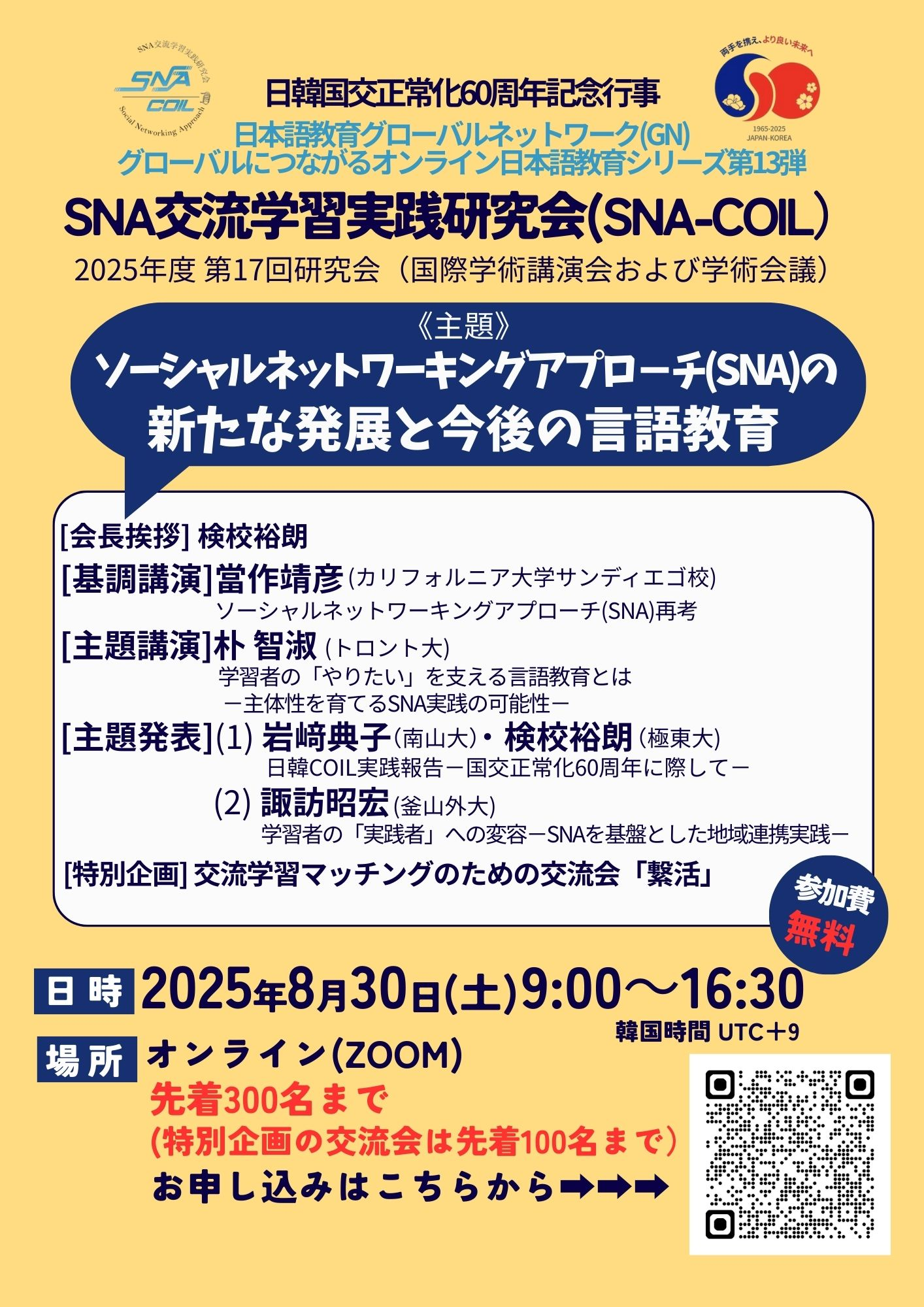
Plenary Lecture
Jisuk Park (University of Toronto, Canada)
What Does Language Education That Supports Learners’ “Desire to Do” Look Like?
Exploring the Potential of SNA Practices for Fostering Learner Agency


Nikkei Spotlight Series “They Don’t Use Our Language Right”: Examining the Impact of “Standard” through the Lens of “Beyond Unit Thinking”Video Available: https://www.youtube.com/watch?v=slV2vM1IHFk Why do people often assume the language you speak by your appearance? Why do some of the language assessments often focus on “accuracy” over effective communication? This talk will challenge the assumption behind these occurrences that “Japan” and “Japanese language” are both homogeneous and overlapping. The talk will thus shed light on the effects of the language standardization, nation-state ideology, and native speakerism. The presentation further analyzes them critically as results of "unit thinking" ― the problematic perception of the world as consisting of discrete, bounded units instead of fluid spectrum (Doerr 2022) and explores ways to overcome such unit thinking.
Consortium Workshop for Language Teaching and Learning
“Working at the Intersection of Language and Culture in the Digital Age: Social Network Approaches (SNA) to the pedagogy of language teaching”
Social Networking Approach, Second Year Japanese Project, "Imagining an Alternative: What if?"
Video Available: https://www.youtube.com/watch?v=rc1CeDrtO2Q This presentation is part of a workshop exploring the application of SNA (Social Networking Approach) in language classrooms and focusing on examining the intercultural components with which students engage global issues.
Online Workshop
“Samazamana Tokuseeno aru gakuseeno shoogai/shooheki no rikai to shien to wa – “dekinai” “muzukashii” ni yorisou torikumi-[Understanding shoogai/shooheki and Assisting Learners with Learning Difficulties – what it means to emphasize with “it is difficult” and “I cannot do this” ]“ online. 2023 Tabunka Kooryuukamoku Online Symposium. Invited Speaker. July 1, 2023